
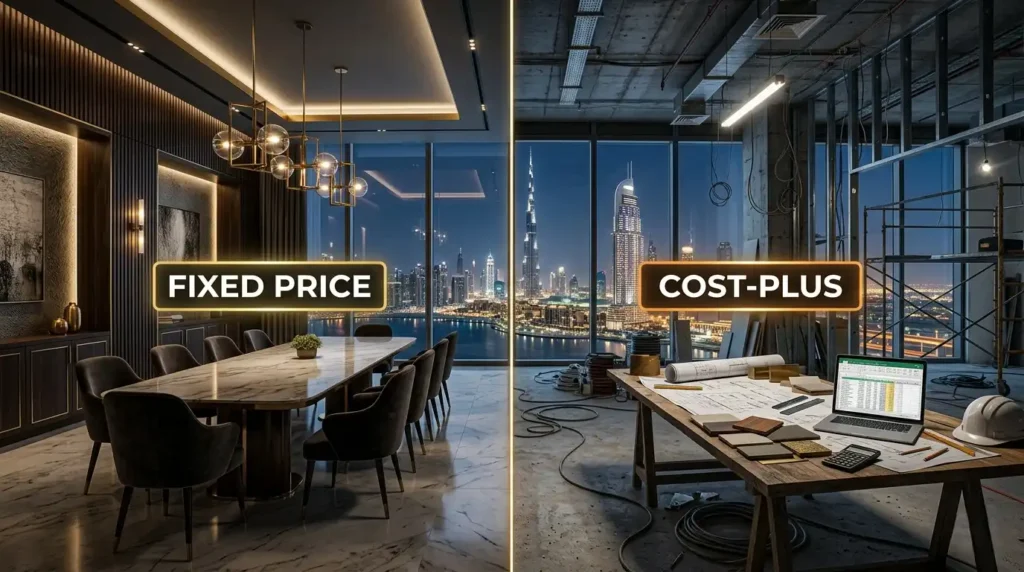
Fixed Price vs Cost-Plus Interior Fit-Out Contracts in Dubai Which Is Right for Your Project?
Before a single partition goes up, before any ceiling tiles are ordered, before your contractor even sets foot on site — you will be asked to sign a contract.
And the type of contract you sign will define your entire fit-out experience. It determines how much you’ll spend, how much risk you carry, how much flexibility you have when things change, and how smoothly the project runs from start to handover.
Yet most business owners and property developers in Dubai sign whichever contract their contractor presents without fully understanding what they’re agreeing to.
This guide explains the two most common interior fit-out contract structures in Dubai — Fixed Price and Cost-Plus — in plain language. By the end, you’ll know exactly which one suits your project, your budget, and your risk appetite.
The Two Contract Types — A Quick Overview
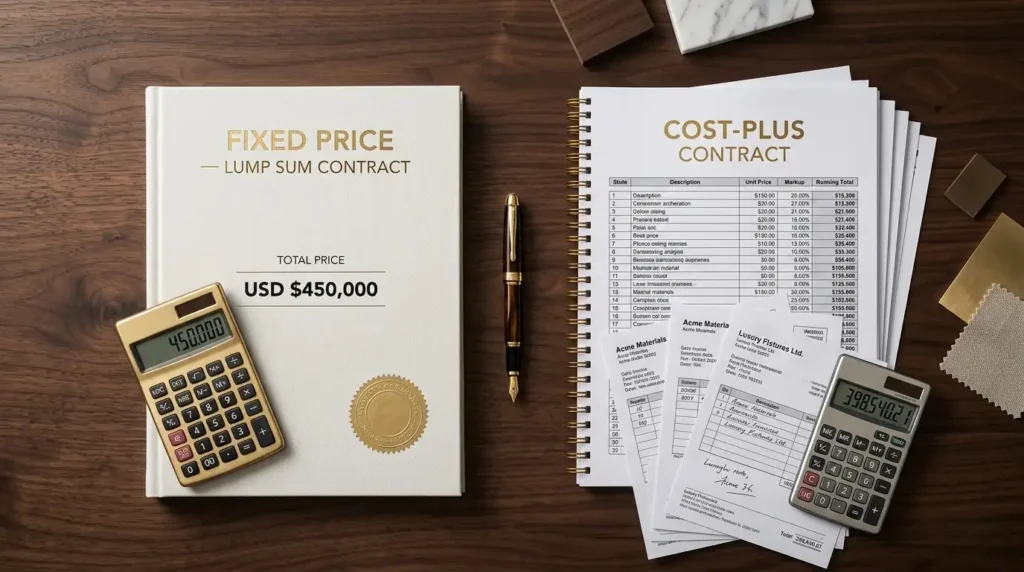
Almost every interior fit-out contract in Dubai falls into one of two structures:
Fixed Price Contract | Cost-Plus Contract |
You agree a single total price upfront. The contractor delivers everything for that amount — regardless of what it actually costs them. Budget certainty is guaranteed. | You pay the contractor’s actual costs — labour, materials, suppliers — plus an agreed fee or percentage on top. Final cost depends on what the project actually requires. |
Fixed Price Contracts — Everything You Need to Know
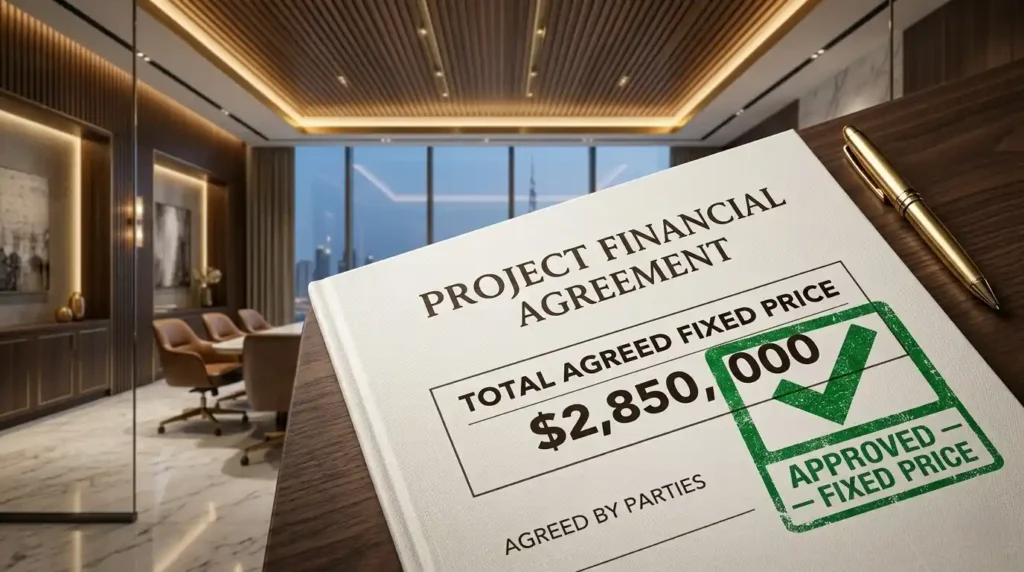
A fixed price contract — also called a lump sum contract — is the most common structure for interior fit-out projects in Dubai. You and your contractor agree on a total price before work begins. That price covers everything in the agreed scope: labour, materials, joinery, MEP, finishes, and project management.
If the project costs the contractor more than they anticipated — due to material price increases, labour complications, or unforeseen site issues — that’s their problem, not yours. Your price stays the same.
The Advantages of Fixed Price
- Complete budget certainty — you know your total spend before signing
- Lower financial risk for the client — cost overruns are absorbed by the contractor
- Simpler to manage — one invoice structure, no need to review supplier receipts
- Contractor is incentivised to work efficiently and on schedule
- Easier to compare quotes from multiple contractors — same scope, different prices
- Banks and investors prefer fixed price for project financing purposes
The Limitations of Fixed Price
- Less flexibility — any scope change requires a formal variation order with a new price
- Variations can be expensive — contractors price changes at a premium because they carry the risk
- Less transparency — you don’t see the breakdown of material and labour costs
- Requires a very well-defined scope before signing — gaps in the brief become contractor leverage
- Contractor may cut corners on quality to protect their margin if not properly supervised
Cost-Plus Contracts — Everything You Need to Know
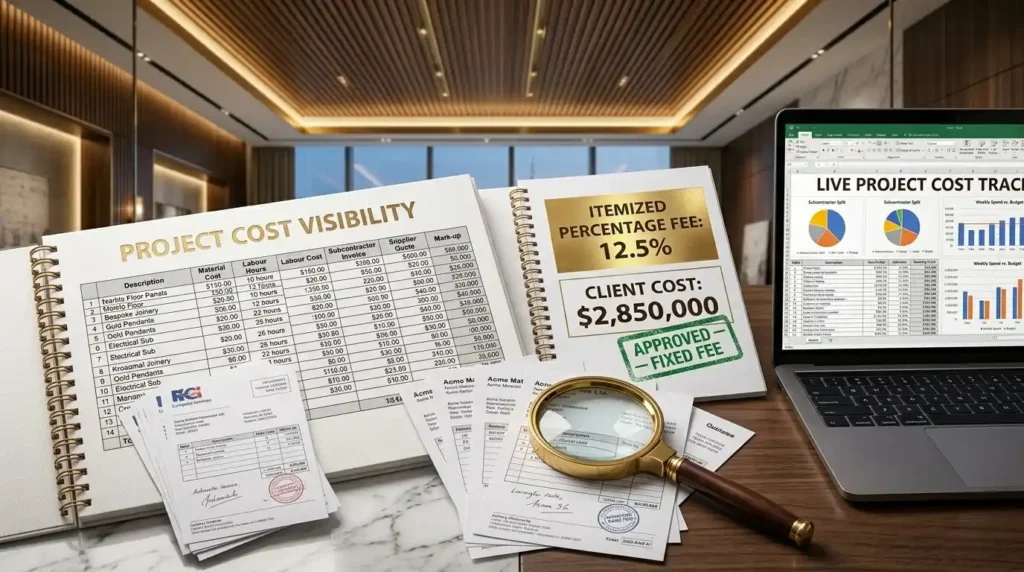
A cost-plus contract works differently. Instead of agreeing a total price upfront, your contractor charges you for the actual cost of every element — every material purchase, every labour hour, every subcontractor invoice — and adds an agreed fee on top. That fee is either a fixed management fee or a percentage of total costs (typically 10–20% in Dubai).
The appeal is full transparency: you see every invoice, every supplier quote, every purchase order. Nothing is marked up invisibly. The challenge is that your final cost is unknown at the start — it depends entirely on what the project ends up requiring.
The Advantages of Cost-Plus
- Complete transparency — you see every cost, every receipt, every supplier invoice
- Maximum flexibility — scope can evolve without expensive formal variation orders
- Ideal for bespoke, complex, or design-led projects where scope isn’t fully defined
- Quality materials are more likely — contractor has no incentive to use cheaper alternatives
- Better for phased projects or those where decisions are still being made during construction
- Client retains more control over purchasing decisions and supplier selection
The Limitations of Cost-Plus
- Complete transparency — you see every cost, every receipt, every supplier invoice
- Maximum flexibility — scope can evolve without expensive formal variation orders
- Ideal for bespoke, complex, or design-led projects where scope isn’t fully defined
- Quality materials are more likely — contractor has no incentive to use cheaper alternatives
- Better for phased projects or those where decisions are still being made during construction
- Client retains more control over purchasing decisions and supplier selection
Head-to-Head — Fixed Price vs Cost-Plus Compared
Here is a full side-by-side comparison across every factor that matters for a Dubai interior fit-out project:
Factor | Fixed Price Contract | Cost-Plus Contract |
Budget certainty | ✅ 100% — price agreed upfront | ❌ Final cost unknown at start |
Risk of overspend | ✅ Zero — contractor absorbs overruns | ❌ Client absorbs all overruns |
Transparency of costs | ⚠️ Lump sum — less itemised | ✅ Full itemised breakdown visible |
Flexibility mid-project | ⚠️ Changes cost extra (variations) | ✅ Easy to adjust scope anytime |
Best for clear scope | ✅ Ideal | ⚠️ Not needed if scope is clear |
Best for evolving scope | ❌ Variations get expensive | ✅ Ideal |
Speed to start | ✅ Fast — sign and go | ⚠️ Slower — ongoing cost tracking |
Contractor incentive | ✅ Motivated to be efficient | ⚠️ Less incentive to save |
Dispute risk | ⚠️ Variations cause disputes | ⚠️ Cost overruns cause disputes |
Who controls quality | Contractor (to protect margin) | Client has more direct oversight |
Most common in Dubai | ✅ Yes — standard for fitouts | ⚠️ Less common — bespoke projects |
When Should You Choose Fixed Price?
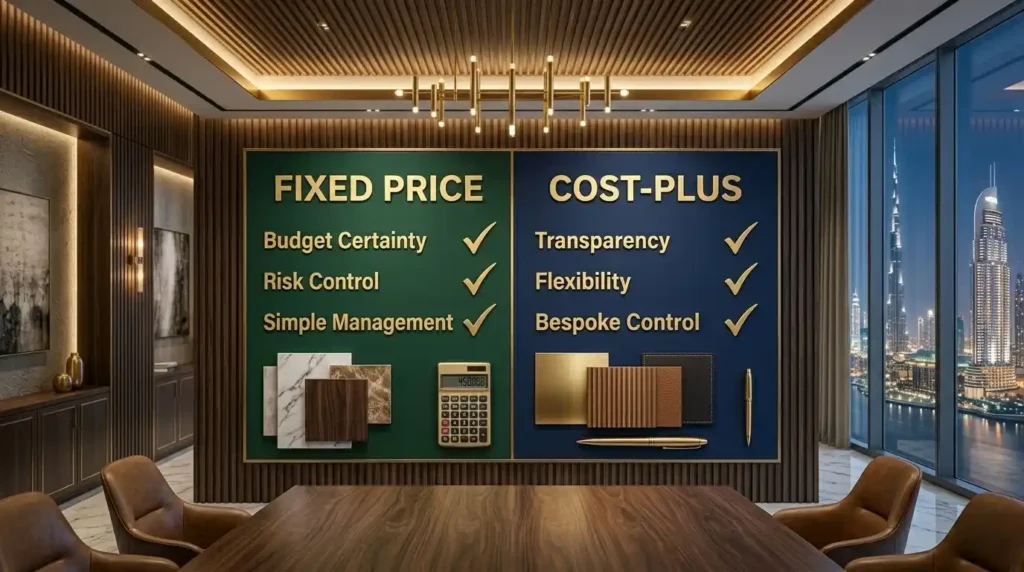
Fixed price is the right choice for the majority of interior fit-out projects in Dubai. Here is when it works best:
- Your design is fully finalised — floor plans, material specifications, joinery drawings — before you go to tender
- You are fitting out a standard office, retail store, restaurant, or clinic where the scope is well understood
- You have a fixed budget that cannot be exceeded under any circumstances
- You are working to a hard opening deadline and need the contractor fully committed to a delivery date
- You are a first-time fit-out client who does not have the capacity to manage ongoing cost reporting
- You are financing the project through a bank or investor who requires a fixed cost commitment
At Design Divine, the vast majority of our projects are delivered on fixed price turnkey contracts. Our clients get a single number — total, transparent, agreed upfront — and we deliver everything for that number. No surprises.
When Should You Choose Cost-Plus?
Cost-plus suits a specific type of project and client profile. It is the right choice when:
- Your design is still evolving when construction needs to start — common in hospitality and bespoke residential
- You are developing a truly one-of-a-kind luxury space where standard pricing is impossible
- You are an experienced developer who wants full visibility and control over every purchasing decision
- The project involves highly experimental or custom materials that cannot be priced with confidence upfront
- You are working on a phased fit-out where each phase informs the next
- You have a trusted, long-term relationship with your contractor and are confident in their cost reporting
Which Contract Type Is Right for Your Project?
Use this decision table to identify the right structure for your specific situation:
Your Situation | Best Contract Type | Reason |
You have a fixed budget you cannot exceed | Fixed Price | Total cost locked before you sign |
Design is fully finalised before work starts | Fixed Price | No ambiguity = no risk of variations |
You are fitting out a retail or standard office space | Fixed Price | Scope is clear and well-defined |
You are working to a hard deadline | Fixed Price | Contractor is incentivised to deliver on time |
Design is still evolving when work needs to start | Cost-Plus | Scope flexibility without penalty variations |
It is a bespoke, one-of-a-kind luxury project | Cost-Plus | Premium custom work is hard to price rigidly |
You want full visibility of every cost and supplier | Cost-Plus | All receipts and invoices disclosed |
You are an experienced developer comfortable managing | Cost-Plus | Hands-on clients can leverage transparency |
You are a first-time fit-out client in Dubai | Fixed Price | Simpler, lower risk, easier to manage |
The Hidden Costs Nobody Tells You About — In Both Contract Types
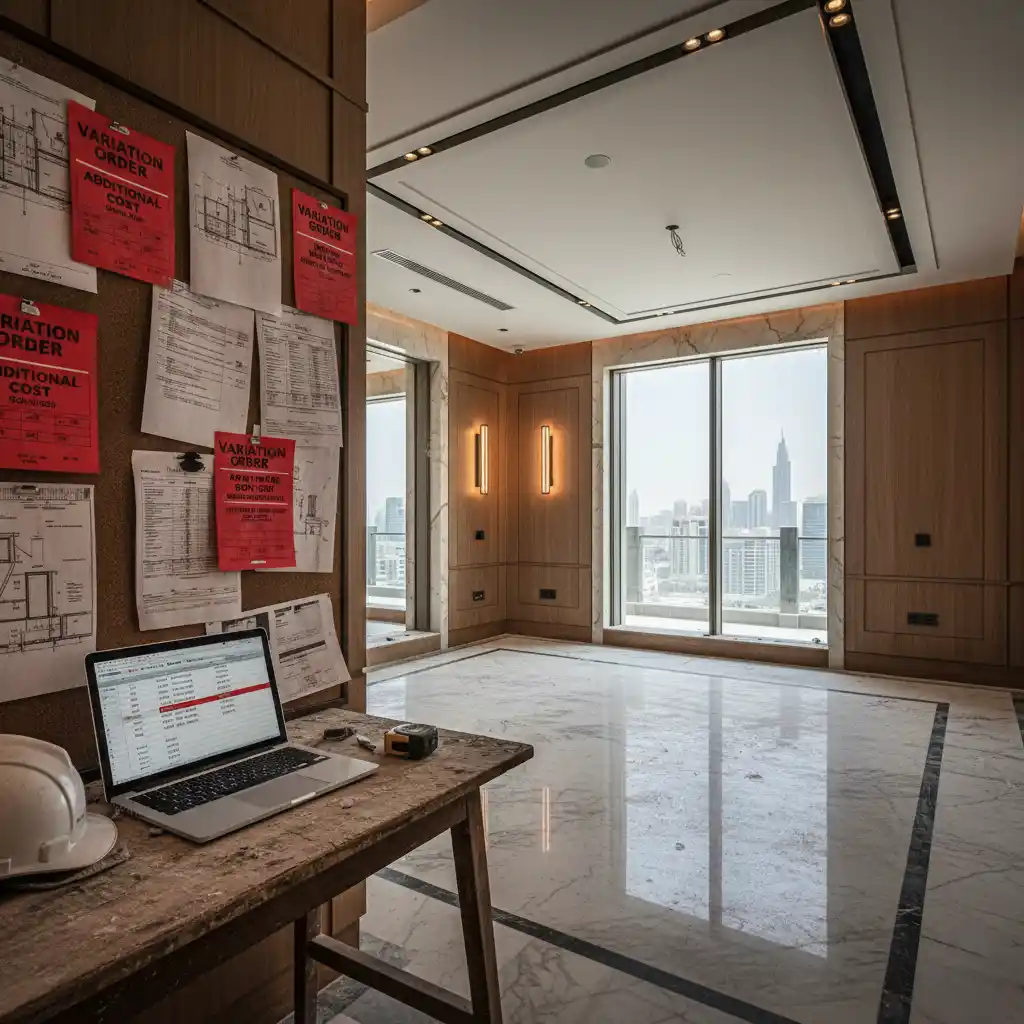
Regardless of which contract structure you choose, there are costs that catch Dubai fit-out clients off guard. Here is what to watch for:
Authority Approval Fees
Dubai Municipality, Dubai Civil Defence, DEWA, and other authority approval fees are real costs that are sometimes not included in contractor quotes. Always confirm in writing whether your quote includes authority fees or whether they are payable separately. At Design Divine, our authority approvals service includes all government fees in a transparent, itemised quotation.
Variation Orders in Fixed Price Contracts
Any change you request after the contract is signed — a different tile, a revised partition layout, an additional power point — becomes a formal variation order. Contractors price variations at a higher rate because they carry the full risk. The more incomplete your brief was at signing, the more variations you will face. This is the most common source of budget overruns in fixed price contracts in Dubai.
Furniture, Fixtures and Equipment
Most fit-out contracts cover construction and finishes — not furniture, loose equipment, signage, or IT infrastructure. These are often budgeted separately and can add 15–30% to your total project cost depending on the space type. Confirm explicitly what is and is not included in your contractor’s scope before signing.
Escalation in Cost-Plus Contracts
Material prices in Dubai fluctuate with global supply chains, currency movements, and seasonal demand. In a cost-plus contract, every price increase is passed directly to you. A project that starts in January may have significantly different material costs by the time purchasing happens in March or April. Build a 10–15% contingency into your budget for any cost-plus project.
Defects Liability and Retention
Standard construction contracts in Dubai include a Defects Liability Period (DLP) — typically 12 months after handover — during which the contractor must fix any defects at no additional cost. Make sure your contract includes this clause regardless of which pricing structure you use. A 5–10% retention is also standard — held back until successful DLP completion.
5 Questions to Ask Any Fitout Contractor Before Signing a Contract in Dubai
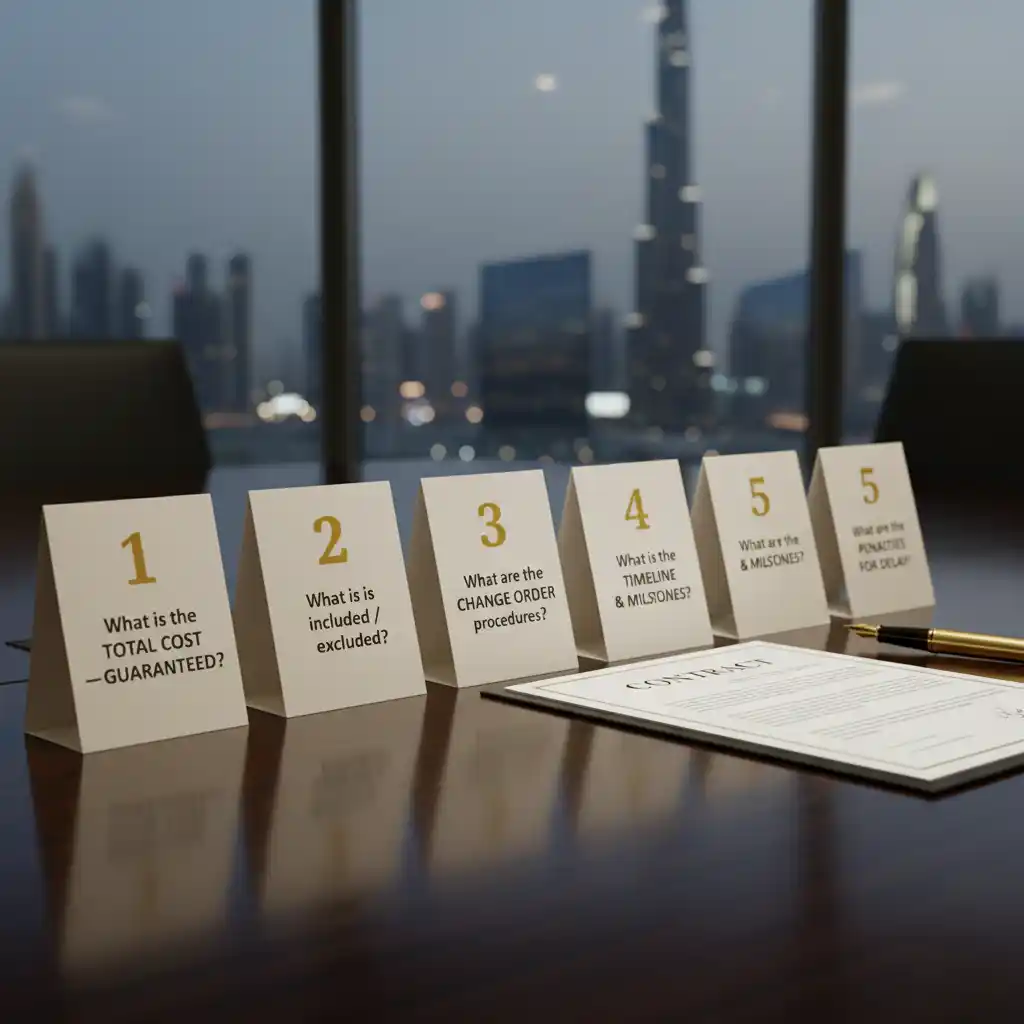
Before you commit to any contract — fixed price or cost-plus — ask these five questions. The answers will tell you everything about the contractor’s professionalism and your financial safety:
- Is the scope of works fully itemised? — Ask for a detailed Bill of Quantities, not just a single lump sum. A professional interior fitout company in Dubai will always provide line-by-line pricing.
- What is the variation order process? — Understand exactly how scope changes are priced, approved, and charged. Ask for the variation mark-up percentage upfront.
- Are authority approval fees included? — Get written confirmation of what authority fees are included or excluded from the quoted price.
- What is the payment schedule? — Never pay more than 20–30% upfront. Payments should be milestone-linked to measurable on-site progress.
- What does the Defects Liability Period cover? — Confirm the DLP duration, what it covers, and how the retention is structured and released.
The best interior fitout companies in Dubai welcome these questions. A contractor who is vague or evasive when answering them is a red flag.
Why Design Divine Uses Fixed Price Turnkey Contracts — And What That Means for You
At Design Divine, our standard delivery model is a fixed price turnkey contract. We manage everything — design, authority approvals, MEP, joinery, finishes, project management, and final handover — under a single agreed price.
Here is what that means in practice for every client we work with:
- You receive a fully itemised quotation before signing — every trade, every material category, every approval fee broken out
- Your total project cost is agreed and locked before a single worker arrives on site
- Any variation you request is formally priced, approved by you in writing, and tracked separately from the original contract
- Authority approvals are managed in-house — our team handles DM, DCD, DEWA, and free zone submissions
- You have a single point of contact throughout — one project manager, one company, one contract
- We do not use cost-plus as a default — only for genuinely bespoke projects where fixed pricing is not appropriate
Our clients range from first-time business owners fitting out their first café to experienced developers managing portfolio fit-outs across multiple Dubai locations. In every case, the contract structure we recommend is the one that genuinely serves the client — not the one that is easiest for us.
What to Do Next — Your Action Plan
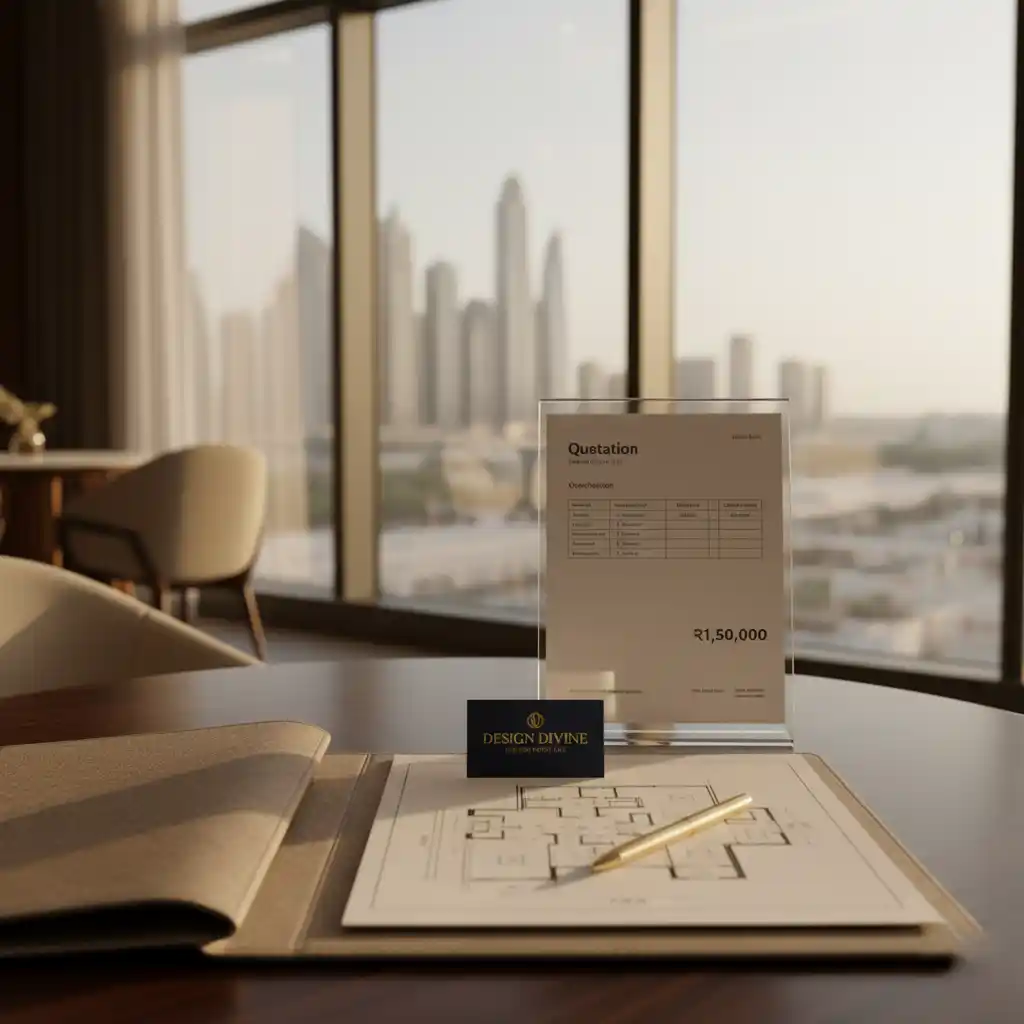
If you are planning an interior fit-out in Dubai and want to understand your contract options properly before committing, here is your next step:
- Define your scope as clearly as possible — the more detail you have before going to tender, the better your fixed price quote will be and the fewer variations you will face.
- Request fully itemised quotes from contractors — not lump sums. A professional interior fitout company in Dubai will always provide line-by-line pricing.
- Ask each contractor explicitly: is this fixed price or cost-plus? What is included? What is excluded? What is the variation process?
- Compare quotes on a like-for-like basis — same scope, same materials specification, same approval inclusions.
- Contact Design Divine for a free consultation — we will review your project scope, explain exactly what contract structure we recommend for your situation, and provide a transparent, itemised quotation.
Further reading that will help you plan your project:
FAQ – Frequently Asked Question — Fixed Price vs Cost-Plus Fit-Out Contracts in Dubai
A fixed price contract — also called a lump sum contract — is an agreement where the client and contractor agree a single total price for the entire fit-out project before work begins. This price covers all labour, materials, and project management within the agreed scope. The client’s cost is fixed and does not change regardless of what the project actually costs the contractor to deliver. It is the most common contract structure for interior fit-outs in Dubai.
A cost-plus contract means the client pays the contractor’s actual costs — every material, every labour hour, every subcontractor — plus an agreed management fee on top. The fee is either a fixed amount or a percentage of total costs, typically 10–20% in Dubai. The final project cost is not known at the start and depends on what the project requires. It offers complete cost transparency but no budget certainty.
Fixed price is almost always better for first-time fit-out clients in Dubai. It gives you complete budget certainty, lower financial risk, and a simpler project structure to manage. You agree a total price, the contractor delivers, and you are not exposed to cost overruns. Cost-plus requires active cost management experience and ongoing invoice review that most first-time clients are not equipped for.
Yes — through formal variation orders. Any change you request to the agreed scope after signing becomes a variation, which the contractor prices separately and you must approve in writing before the work proceeds. Variations are typically priced at a premium in fixed price contracts because the contractor carries the delivery risk. The best way to minimise variations is to ensure your scope of works is fully and clearly defined before the contract is signed.
A turnkey fit-out means one contractor takes full responsibility for everything under a single contract — design, approvals, procurement, construction, and handover. When combined with a fixed price structure, it gives the client both scope simplicity and budget certainty. You sign one contract, agree one price, and receive a completed, ready-to-use space at handover. Design Divine specialises in fixed price turnkey fit-out contracts across Dubai.
It depends on the contractor — and this is one of the most important things to confirm before signing. Some contractors include all DM, DCD, and DEWA authority fees in their quoted price. Others exclude them and charge separately. Always ask for a written breakdown of what is and is not included in your quoted price. At Design Divine, authority approval fees are always itemised clearly in our quotations with no hidden charges.
A Maximum Guaranteed Price (MGP) — sometimes called a Guaranteed Maximum Price or GMP — is a contractual cap on the total amount a client can be charged under a cost-plus agreement. Even if actual costs exceed the cap, the client pays no more than the MGP. This is strongly recommended for any cost-plus fit-out contract in Dubai. It gives you the flexibility of cost-plus while capping your financial exposure. Always negotiate an MGP clause before signing a cost-plus contract.
Payment schedules in Dubai fit-out contracts are typically milestone-based. A common structure is: 20–30% mobilisation payment on signing, followed by progress payments tied to measurable construction milestones — such as completion of MEP first fix, completion of joinery installation, completion of finishes — with a final payment of 5–10% held as retention until the defects liability period is satisfied. Never agree to pay more than 30% before construction has visibly started on site.
A Defects Liability Period is a contractual obligation for your contractor to fix any defects that appear in the completed fit-out — at no additional cost — within a specified period after handover. In Dubai, the standard DLP for interior fit-outs is 12 months. It is essential that your contract includes a clearly defined DLP and a retention clause — typically 5–10% of the contract value held until DLP expiry. Design Divine includes a standard 12-month DLP in all fit-out contracts.